


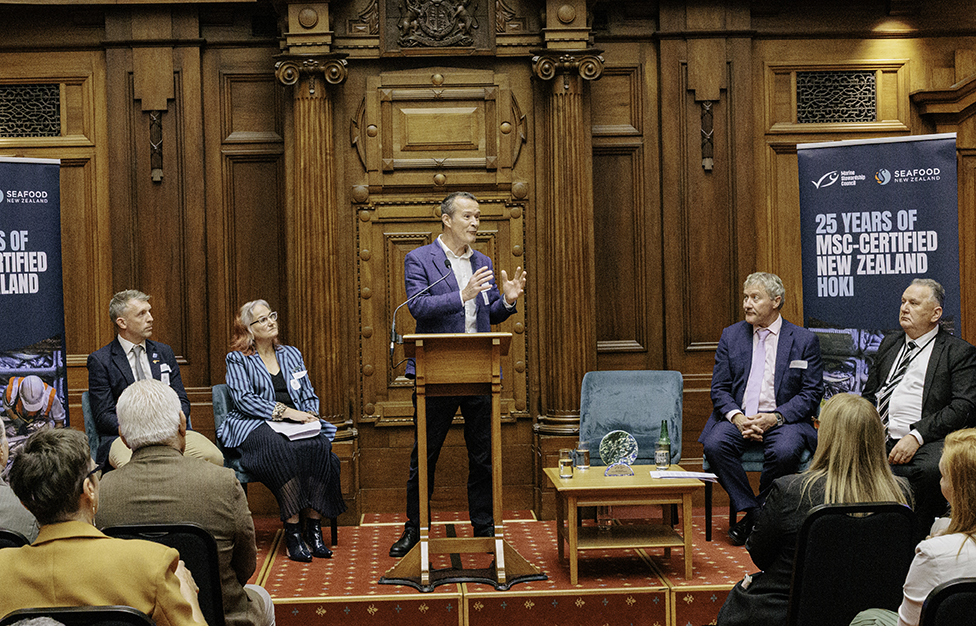
Behind one of New Zealand’s most valuable fisheries lies decades of science, collaboration, and careful stewardship.
WELLINGTON, New Zealand – New Zealand’s hoki fishery has reached a global milestone, marking 25 years of independent certification under the Marine Stewardship Council (MSC) standard. The longest-running certified whitefish fishery in the world, it has now been recertified for a further five years.
Almost 20% of the world’s wild-caught marine catch is now engaged in the MSC program, with that figure more than double in New Zealand at 45%, reflecting a growing shift toward independent certification.
The hoki fishery is one of New Zealand’s largest and most valuable commercial fisheries, contributing significantly to global whitefish supply and food security. Supplying export markets across Europe, Australia and Asia, the fishery generates around NZ$230 million annually and supports hundreds of jobs across harvesting, processing and research.
In the 2023-24 fishing year, over 100,000 tonnes of hoki were landed, equivalent to 250 million standard fish servings, enough to provide around eight sustainable seafood meals for every New Zealander and Australian.
The hoki fishery operates within New Zealand’s Quota Management System, with catch limits informed by ongoing stock assessments and monitoring. Hoki is managed across the eastern and western stocks, enabling harvest decisions to respond to changing environmental conditions.
In 2018, fishers observed fewer hoki than expected. Industry responded by requesting that catch limits be cut by more than 10% for two consecutive years, resulting in an overall reduction of 35,000 tonnes of West Coast hoki and helping to accelerate the stock’s full recovery.
Rupert Howes, Chief Executive of the Marine Stewardship Council, an international non-profit with a mission to end overfishing, said reaching the 25-year milestone demonstrates what sustained commitment to science-based fisheries management can achieve. “Reaching 25 years of certification is a remarkable achievement and something truly worth celebrating,” he said. “It reflects decades of dedication from fishers, scientists and fisheries management agencies in New Zealand who have worked together to manage this fishery responsibly and ensure hoki stocks remain healthy for the future.”
Seafood New Zealand Chief Executive Lisa Futschek said the anniversary reflects collaboration between the seafood sector and the scientific community “This milestone is really about the people behind the fishery - the skippers and crews out on the water and the scientific community guiding their efforts. It reflects years of hard work and care. Achieving this milestone hasn’t been easy - it’s been earned, and it helps keep confidence strong in our hoki and its place on dinner plates in New Zealand and around the world.”
The fishery has been recertified against a more stringent version 3.1 of the MSC Fisheries Standard following an independent assessment by third party auditors looking at stock health, ecosystem impacts and fisheries management.
Richard O’Driscoll, Chief Scientist Fisheries at Earth Sciences New Zealand, said long-term monitoring and modelling help managers understand how hoki populations respond to environmental variability and fishing pressure. “Combining survey data with information from the fishery informs evidence-based decisions that support the long-term resilience of hoki stocks. This is supported by extensive monitoring, including independent observers, satellite tracking, and digital catch recording.”
Aaron Irving, General Manager Deepwater at Seafood New Zealand, said the recertification shows the strength of New Zealand’s fisheries management system, noting that “Achieving MSC certification for our hoki, hake, ling, and southern blue whiting fisheries is an independent verification of the strength and integrity of our fisheries management system here in New Zealand.”
Looking ahead, the Marine Stewardship Council says it expects the New Zealand hoki fishery to build on its 25-year track record by strengthening ecosystem understanding, expanding digital monitoring and integrating climate considerations into management, ensuring it continues to meet rising global expectations for sustainable fishing.