



A Decades-Long Path to Sustainability for the BC Groundfish Trawl Fishery
Bottom trawl fishing plays a major role in feeding the world. About one quarter of the world’s wild seafood catch comes from bottom trawl fishing, supplying hundreds of millions of affordable, high-protein meals each year and supporting coastal communities around the world.
But bottom trawling has also faced serious questions. How do you harvest fish that live near the ocean floor without damaging sensitive habitats? How do you prevent overfishing when multiple species are caught together? And how do you ensure accountability at sea?
On Canada’s west coast, the BC Groundfish Trawl Fishery set out to answer those questions. Over the past three decades, fishers, scientists, conservation organizations and government worked together to redesign how the fishery operates. The result is one of the most comprehensive monitoring and accountability systems in commercial fishing—with clear catch limits, 100% at-sea monitoring, and strict protections for vulnerable habitats.
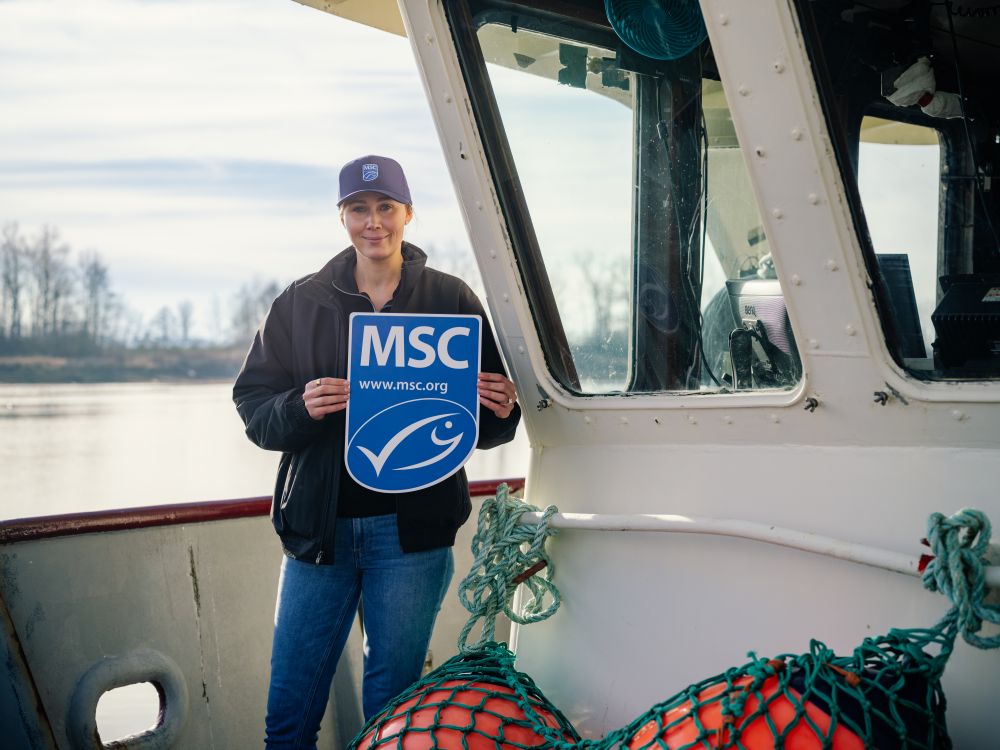
In December 2025, BC Groundfish Trawl Fishery received certification to the Marine Stewardship Council (MSC) Fishery Standard for environmentally sustainable fishing covering 16 species.
This is the story of how a complex fishery evolved to meet modern sustainability standards.
BC Groundfish Trawl Fishery Today
22% reduction in trawl footprint from historic levels
80% of sensitive deep-sea habitats permanently protected
90%+ reduction in coral and sponge bycatch
100% at-sea electronic monitoring
From Derby Fishing to Accountability
Before 1995, the BC Trawl Fishery operated under what was known as a “derby” system. Each season, Fisheries and Oceans Canada (DFO) set a total allowable catch (TAC) for each species. That number applied to the entire fleet. Once the limit was reached, catch was prohibited and restrictions were put on fishing time and location.
So what did that mean out on the water? It was a race. With a fixed number of licenses and one shared quota, vessels raced to catch as much as they could, as quickly as they could, before fishing opportunities were restricted.
“It’s also known as the Olympic fishery,” explains Bruce Turris, former executive manager of the Canadian Groundfish Research and Conservation Society (CGRCS), “because everyone’s racing to maximize their opportunity.”
The system created intense pressure. Seasons were often short and unpredictable. Once the total allowable catch was reached, the fishery was severely restricted—sometimes with little notice.
At the same time, monitoring lagged behind reality. Catch reporting relied on paper logbooks and sales reports that were submitted weeks after fish had been caught. By the time managers knew how much fish had been landed, the fleet had often already exceeded the limits.
In September 1995, DFO shut down the fishery for the first time since the 1940s. “It was a necessary step, because the resource was being seriously over-harvested,” Turris says.
When the fishery reopened in 1996, it did so under a completely new model—one built around individual quotas, monitoring and real accountability.
Individual Transferrable Quotas
The new system introduced the Individual Transferrable Quota—or ITQ. Here’s how it works: Instead of one big, shared limit for the entire fleet, the total allowable catch is divided into shares. Each licence holder receives a specific percentage of the overall catch for each species. That share belongs to them. And every single pound of fish they land must be covered by quota.
If a fisher sets out to catch cod but also catches rockfish—common in a multi-species fishery—they need quota for both. If they don’t hold enough, they have to acquire it from someone who does.
“When you do that across all of the groundfish fisheries,” Turris explains, “all fish is accounted for, all fish comes off the total allowable catch, and you truly have a sustainable harvest level.”
The shift reshaped incentives. Under the old derby system, fishers raced against one another. Under ITQs, they fish within clearly defined limits. There’s no frantic sprint to beat a closure. If a stock declines, each fisher’s share declines, too. “If the resource is being over-harvested, your share shrinks,” Turris explains. “So the incentive is to keep it healthy.”
100% At-Sea and Dockside Monitoring
Quotas only work if they’re verified.
In the BC Groundfish Trawl Fishery, monitoring is comprehensive. From the moment the boat leaves the dock, cameras record activity on board. Boats carry up to 16 cameras and GPS tracks movements. Gear sensors monitor where nets are in the water at all times, and how much fish is being caught. At the dock, an independent monitoring company verifies and weighs all landings.
“BC Groundfish Trawl Fishery is unique in that it is the only multi-species fishery I know of in the world where every pound of fish that is caught is accounted for,” says Turris.
For fishers, that transparency reinforces trust. “The cameras keep everybody honest,” says Skipper Dean Clark.
For managers, it provides reliable data. “It really gave us the confidence to know exactly what is being caught,” says Dana Haggarty, Groundfish Section Head in the Stock Assessment and Research Division at Fisheries and Oceans Canada. “It also allowed everyone in the fishery to have confidence that the reports were actually truthful.”
The Habitat Conservation Agreement
Stock accountability was only part of the solution. Habitat impacts also had to be addressed. In the early 2000s scientists and environmental non-governmental organizations (ENGOs) raised concerns about fishing impacts on sensitive habitats and features like deep-sea corals and sponges.
These organisms grow slowly and can live for decades or even centuries. They provide important habitat for many marine species, and once damaged, can take a very long time to recover.
“The science was clear,” says John Driscoll, former Fisheries Science and Policy Analyst at Living Oceans Society. “When bottom trawls encounter sensitive habitats like corals and sponges, they do substantial damage.”
The response was collaborative.
The BC trawl industry, represented by vessel owners, the CGRCS and the Deep Sea Trawlers Association of B.C., sat down with ENGOs including Living Ocean Society and The David Suzuki Foundation, to negotiate the Pacific Groundfish Trawl Habitat Conservation Agreement (HCA). In 2012, DFO incorporated the measures into its management plan, making them mandatory.
Protecting Coral and Sponge
The agreement introduced a global first: individual vessel limits on coral and sponge bycatch—corals and sponges accidentally caught when targeting fish.
Each vessel received a small quota for coral and sponge bycatch. Exceed it and the vessel would have to cease fishing or obtain additional quota. The limit created a strong incentive to avoid sensitive habitats.
“The fishery already had 100% at sea observer coverage and an existing quota system for their target species,” notes Driscoll. “Without those elements, we would not have been able to do what we did with the Habitat Conservation Agreement.”
The results were measurable. Coral and sponge bycatch dropped by almost 90 percent, and fishers actively avoided those areas.
“We go out of our way to avoid sensitive habitats,” says Clark. “They're closed for a reason, and that's to protect the coral.”
Defining the Trawl Footprint
Another outcome was a permanent trawl footprint that defined where bottom trawling was allowed, and prevented expansion into previously untrawled areas.
The footprint was immediately reduced by 22 percent, permanently protecting more than 80 percent of deep-sea habitat deeper than 800m along the B.C. coast.
Technology Advancements
Technology reinforced these changes. Many vessels replaced the traditional bottom-contact trawl doors with pelagic doors that stay off the seafloor. Larger mesh sizes and escape panels allow smaller fish and non-target species to swim free. Sounders and sensors help fishers avoid fragile rocky habitats and target soft-bottom seafloors that recover more quickly.
“The trawl fishery today is very selective,” explains Clark. “When somebody gives me a grocery list of what they need, I know exactly where to go to get that.”
Why MSC Certification Matters
In December 2025, following an almost year-long independent assessment of those reforms, the fishery achieved certification to the Marine Stewardship Council Fisheries Standard—a rigorous evaluation of stock health, ecosystem impacts and management effectiveness.
“This fishery is meeting a world-class standard for sustainability,” says Kurtis Hayne, Program Director for MSC Canada.
Certification means an independent third party has verified that the fishery meets internationally recognized standards. For buyers and consumers, it provides confidence that sustainability claims are backed by evidence.
A Fishery of the Future
The transformation of the BC Groundfish Trawl Fishery wasn’t the result of one policy or one agreement. It was the result of structural reform: incentives realigned, habitats protected, and monitoring made transparent. “There wouldn’t be a groundfish trawl fishery today if we hadn’t made these changes,” Turris says.
Not all fisheries operate this way. But the BC Groundfish Trawl Fishery demonstrates something important: when science guides decisions, accountability is real, and long-term stewardship aligns with economic survival, sustainable trawling is possible.