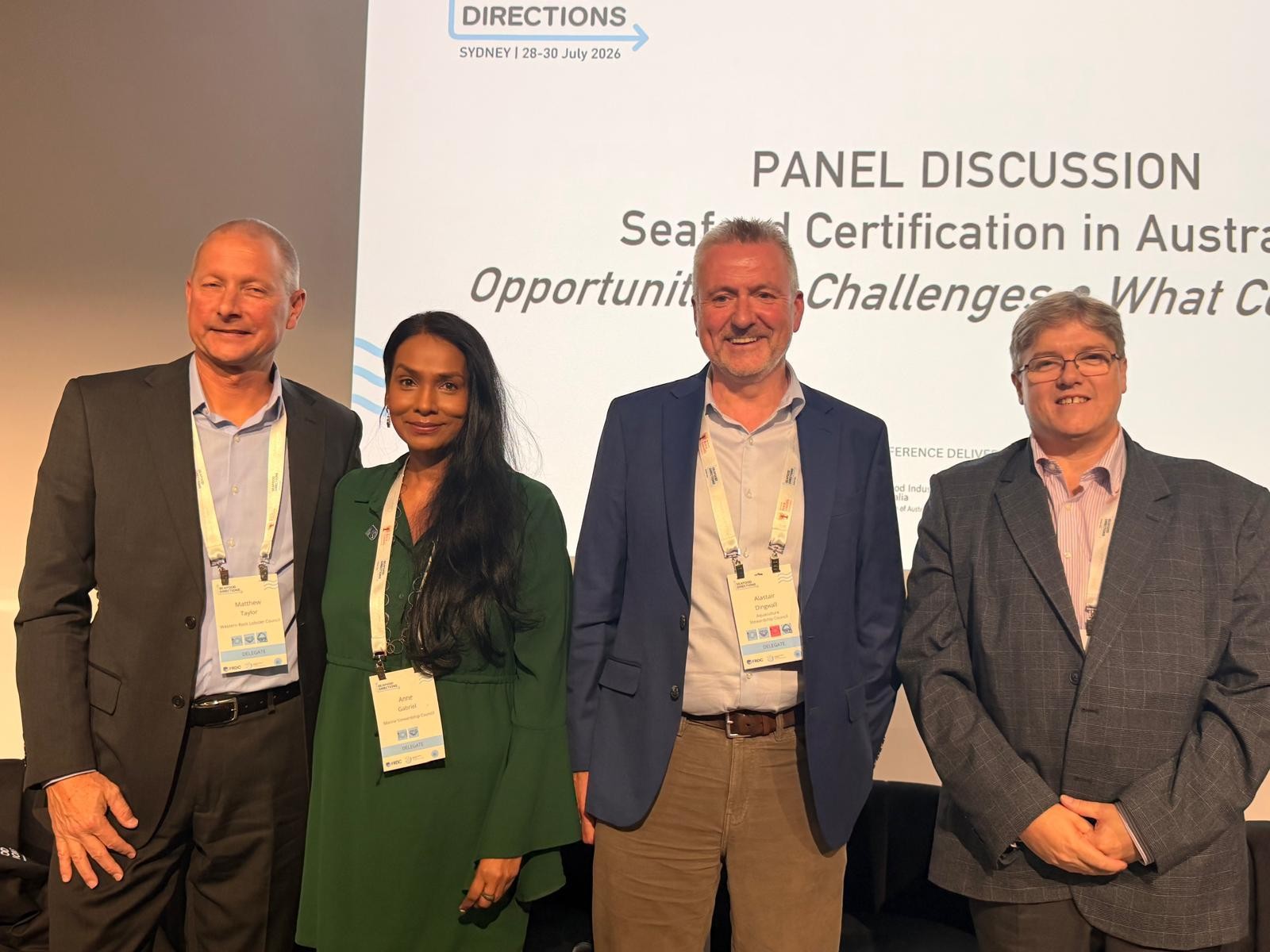

It was a privilege to join Matt Taylor of Western Rock Lobster, Alistair Dingwall from the Aquaculture Stewardship Council (ASC) and Huw Thomas from the Global Dialogue on Seafood Traceability (GDST) at Seafood Directions 2026. Each brought deep expertise from fisheries leadership and aquaculture certification to global supply-chain traceability, and it was good to be in company with such expertise.
Matt Taylor reflected on Western Rock Lobster becoming the world’s first MSC-certified fishery in 2000. Its significance extends far beyond being first: its leadership helped build the confidence and momentum for fisheries around the world to follow. As the MSC approaches its 30th anniversary in 2027, more than 19% of the world’s wild marine catch is now engaged with the MSC program.
The Western Australian Government’s commitment, through DPIRD, was not only recognised nationally as pivotal in advancing sustainability and industry leadership but has also become a global case study in how governments can positively inspire, enable and accelerate change.
From the MSC perspective, I spoke about why a consistent global framework matters. Certification does not replace strong fisheries management; it independently verifies performance and provides a common benchmark for governments, industries and markets involved in importing, exporting and sourcing seafood.
For consumers, whether shopping at Coles in Australia, AEON in Japan, Sainsbury’s in the UK or Walmart in the United States - an ecolabel under an independent certification scheme turns complex information about science, environmental impacts, independent assessment and supply-chain traceability into an easy, recognisable and trusted choice.
Alistair brought the aquaculture perspective, including the environmental and social dimensions of responsible production, while Huw highlighted the importance of reliable, interoperable data as seafood moves through complex global supply chains.
The MSC, ASC and GDST are collaborating to strengthen digital traceability helping establish provenance while addressing risks such as food fraud, substitution and illegal, unreported and unregulated fishing.
We also discussed whether global certification schemes are sufficiently accessible to small-scale fisheries. This is a legitimate challenge, particularly where fisheries face barriers involving cost, data and technical capacity. The MSC Improvement Program provides fisheries not yet ready for certification with a structured and independently verified pathway to assess gaps, strengthen management and progress towards the MSC Standard. This work will be critical to achieving the ambition of engaging more than one-third of global marine catch in the MSC program by 2030.
Certification is not without cost or complexity, and there is more to do to reduce duplication, improve accessibility and make better use of existing data. But the answer is not to lower the bar. It is to preserve the independence and scientific rigour that give certification its value while continuing to improve how assurance and digital traceability work together.
My strongest takeaway was that certification and traceability are becoming essential infrastructure for responsible seafood trade. In a world where trust is difficult to earn and easy to lose, they help turn sustainability from a claim into credible, verifiable assurance.
AI was used to assist in the drafting of this article.