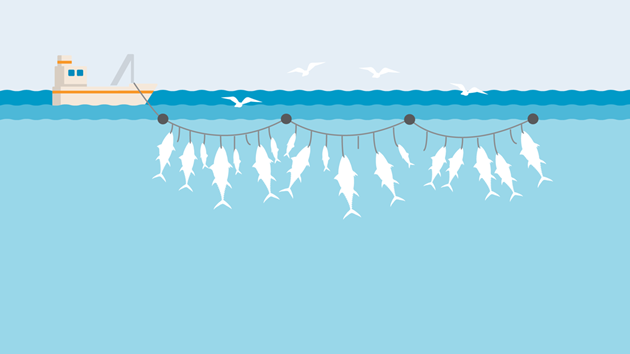
Bottom trawling is one of the most widely used fishing methods in the world.
Globally, trawling accounts for roughly a quarter of all wild seafood caught each year. Trawl fisheries supply some of the most popular seafood species, like cod, pollock, and shrimp.
But bottom trawling can also raise concerns about environmental impacts, like damage to the seafloor and bycatch.
Though not all bottom trawl fisheries are the same. Several MSC certified fisheries in the US and Canada are showing that they can provide seafood while reducing their environmental impact. This is due to things like new technologies, better management, and stronger monitoring.
Innovation that reduces bycatch and seabed impacts
Concerns about habitat impacts and bycatch are well known. These challenges can be addressed through a science-based approach to reducing potential harm.
Any fishery seeking MSC certification must prove that their fishery does not cause serious or irreversible harm to the ocean. This includes trawl fisheries.
To do this, many MSC certified trawl fisheries are investing ways to reduce their environmental footprint. Improved gear design, advanced fish-finding technology, and real-time monitoring systems to help vessels be more precise are just the start.
By focusing fishing activity on areas where target species are abundant, vessels can reduce the time nets spend on the seabed. This one simple change has many benefits. It reduces bycatch risk and fuel consumption, while improving environmental performance. The result is a much more efficient and environmentally friendly fishing operation.
Many MSC certified trawl fisheries in the US and Canada have pioneered innovations that are now used across the fishing sector.
Oregon and Washington pink shrimp fishery
The Oregon and Washington pink shrimp fishery is protecting an endangered fish. They introduced green LED lights on trawl nets to reduce the bycatch of endangered eulachon smelt and other fish species. The technology proved so effective that it has been adopted across the fleet and is now used in many fisheries around the world.
Bering Sea groundfish fisheries
Large-scale management changes have led to environmental improvements in Alaska’s Bering Sea groundfish fisheries. Some fleets have reduced their bottom contact by over 90% compared with historical practices. This is due to cooperative management and new fishing practices put in place by the Alaska Seafood Cooperative. These fisheries were able to dramatically reduce seafloor contact and bycatch without reducing the quantity that the whole community relies on.
British Columbia Groundfish Trawl Fishery
The British Columbia Groundfish Trawl fishery in Canada has gone through a huge transformation. The fishery implemented a collaborative ecosystem-based management plan with industry and conservation partners. The new plan clearly defined trawling boundaries which reduced the fishery footprint by 21.9%. They pioneered a Habitat Bycatch Conservation Limit to control coral and sponge catch. They also created a new rapid-response Encounter Protocol for unexpected habitat interactions. This allows them to quickly adjust fishing practices if needed.
Supporting food security through sustainable fishing
Seafood plays a vital role in global food systems. More than three billion people rely on aquatic (‘blue’) foods as a key source of protein and essential nutrients.
Bottom trawl fisheries supply large volumes seafood that people rely on, like Alaska pollock, cod, and haddock. These are fish species that are often used in everyday products like frozen fillets and fish sticks.
Ensuring these fisheries are well managed helps support ocean health and food security. It also supports the economic sustainability of seafood supply chains, from fishers to retailers. This helps ensure that sustainably sourced seafood is accessible and affordable for consumers.
All food production systems carry environmental impacts. The key question is whether those impacts are governed responsibly.
Under US and Canadian fisheries law and MSC standards, bottom trawl fisheries operate within enforceable limits. These limits are designed to protect ecosystems while continuing to supply seafood around the world.
The MSC Fisheries Standard builds on strong national regulations. It brings globally accepted fisheries science and best practice in fisheries management to the local fishing sector.
Encouraging continuous improvement
Improving fisheries sustainability requires close collaboration between scientists, fishers, regulators, and conservation organizations.
The MSC works with researchers around the world to strengthen understanding of fishing impacts and support fishery innovation.
For example, the MSC collaborated with researchers at Bangor University in the UK to develop the MSC Benthic Impacts Tool. This tool helps fisheries better understand and predict how fishing activities may affect seabed habitats.
Through the Ocean Stewardship Fund, the MSC also supports research and improvement projects. Many of these projects focus on reducing bycatch and protecting marine ecosystems.
The MSC program helps incentivize improvement by recognizing fisheries adopting innovative solutions. This supports both environmental stewardship and the continued existence of fisheries and seafood supply chains.
A shared effort for healthy oceans
Bottom trawling seems likely to remain an important fishing method globally for the foreseeable future. That is why it is so important to ensure it is conducted in an environmentally sustainable way.
For the MSC, sustainable fisheries are defined not by the gear they use, but by the environmental outcomes they deliver.
Across the US and Canada, many MSC certified trawl fisheries are showing that trawling can be done better. A commitment to innovation, science, and strong governance can significantly reduce environmental impacts.
By supporting and recognizing these efforts, MSC certification helps encourage the adoption of better practices across the fishing industry.
The result is an industry that supports a healthy ocean and provides reliable supply of sustainable seafood today and for future generations.