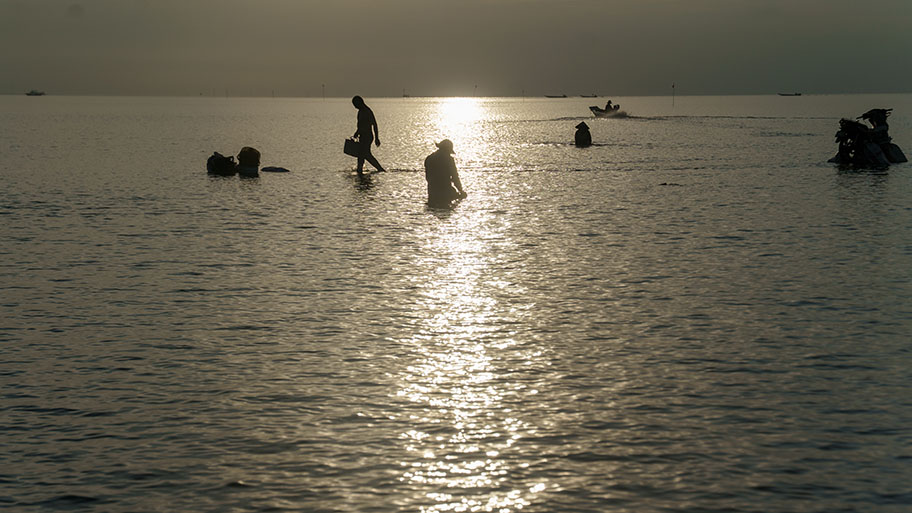
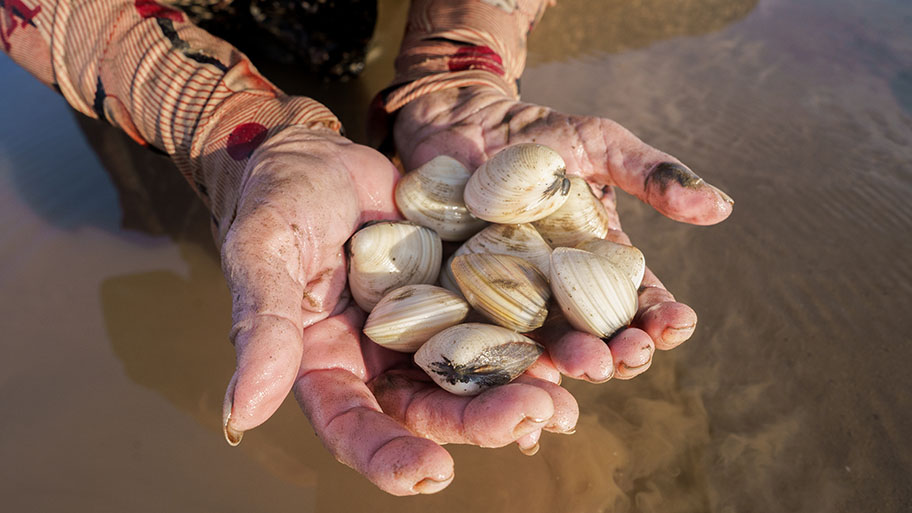
It’s early morning out on the mudflats of Bến Tre in southern Vietnam and the tide is receding. Fishers begin to arrive on small boats along the Mekong Delta’s estuaries. There are local men and women of all ages. All with a common goal. To pluck small ivory shells by hand from the wet sand. They fill up plastic baskets, shaking them often in the shallows, before tipping their “white gold” into large mesh sacks.
These fishers have no fishing lines, but they have grown skilled in their picking, aided by a rake. Clams are burrowed just a few centimeters beneath the sand among snails, crabs, and mussels. “This method is highly selective, arguably among the best in the world,” says Đinh Xuân Nọc, Deputy Director of the Center for International Cooperation in Sustainable Aquaculture and Fisheries.
"People only harvest clams that have reached the legal market size, and smaller clams are left to grow. Fishers also leave about 20% of clams on the beds to maintain the population and serve as broodstock (mature shellfish kept for breeding)."
Timing and technique
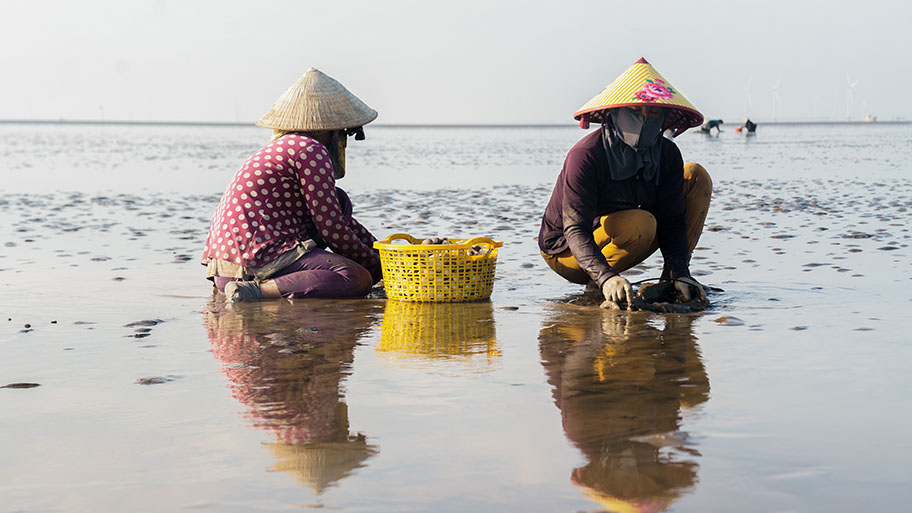
Clam-flat ecosystems are shallow and highly sensitive. If conditions aren’t stable, clams can’t reproduce. Harvesting is managed as a community practice and guided by science. There are restricted seasons, and harvesting only takes place at low tides within an area marked by flags. “In the past, people would harvest at any time, but now we only do it when the tide is right. The clams are easier to collect,” says Nguyễn Quốc Trũng, Executive Director of the Đà Đông Cooperative.
So far, fisheries have not embraced the technological advances common across the sector. "We can’t use machines, even though it would be cheaper and more efficient,” adds Quốc Trũng. "But it's not good for the environment. Hand harvesting is more sustainable. We’ve learned from years of experience that it’s better."
“These days, protecting marine ecosystems from the pressures of development and climate change is crucial,” said Mr Quốc Huy, Representative of SORESIMF, Southern Marine Fisheries Research Branch.
A local lifeline
The clam industry has a long history here. It goes back to the resistance against the French, and continues during the war with America, when the government organised small-scale farming among groups of local people to protect the clams.
Today's well-run fishery began to take shape in 1997. A cooperative formed to put local people at the heart of the fishery.
"In the past, we'd just harvest and sell as we liked, sometimes even giving clams away. But after getting certified, the price of clams went up, and we could sell to more markets. This improved the local economy and social welfare," says Quốc Trũng. "It’s a sustainable model that protects the environment, safeguards resources, and secures the livelihoods of participants."
Having a ticket to gather a quota of clams is a lifeline for many families. "In addition to wages, we receive profit distributions. Together, those two sources keep our household income stable and we can support ourselves and our family," says Ms Phan Thị Thùy Linh, a Member of the Rang Đông Fisheries Cooperative.
“When we harvest, we take only clams; we don’t touch the other wild species."
Mangroves and migratory birds
Maintaining the excellent natural conditions of the coastline and tidal flats for clam fishing is a key component of the fishery’s management. Minimizing impact on the marine environment is a core principle of the MSC Standard. The fishery was certified to the MSC Standard for the third time in late 2023.
"Right now, the biggest challenge is environmental. If it’s unstable, clams won’t reproduce and people won’t have income. That’s what folks here worry about most," says Thùy Linh.
To protect its resources, the fishery has been planting mangroves along the Ba Lai River. This helps to stabilize the environment, buffers waves and wind, and provides nutrients for clams.
Clams are filter feeders, so they help keep the water clean and create good living conditions for other species. Healthy numbers of migratory birds returning are a sign that the environment is functioning well. "They help deal with the natural predators that could affect the clams," says Mr Văn Viết.
Everyone understands the coop’s clam beds are the community’s main livelihood, so they all share responsibility to protect the environment and wildlife. Local people will send away illegal fishers or hunters and if necessary, inform the regional government to take action. "We try to prevent theft," says Thùy Linh. "If boats come in to fish on the flats, we advise them to fish farther offshore, so the beds stay stable, and the clams grow well."
"When clam beds are managed under a community model and certified as sustainable by MSC, they don’t just provide livelihoods – they also help keep coastal waters clean.” Mr Quốc Huy, Representative of SORESIMF, Southern Marine Fisheries Research Branch
Facing the future
Once a serious problem, illegal harvesting has been dramatically reduced by community led eliminated through a combination of community-led initiatives such as the introduction of a fisher ID card system, and the use of security guards and viewing platforms to monitor activity.
"We have to keep changing and improving management. We’re also thinking about buying cameras to monitor the beds. It’s a combination of working with local and national authorities to protect the resources." Quốc Trũng.

However, rises in sea temperatures, saltwater intrusion, and off-season storms are known factors contributing to stress on clam resources in Vietnam. The local government says clam productivity is declining in the coastal provinces of the Mekong Delta. "The average clam size is smaller and resilience is weaker," says Đinh Xuân Nọc. "A well protected environment like Bến Tre’s is extremely valuable. It preserves pure broodstock for the Mekong Delta and for Vietnam more broadly."
Mr Văn Viết remains optimistic about the future. "I hope, building on the foundation in Bến Tre and Trà Vinh, we can expand MSC certified clam areas and increase protected zones, bringing more value to communities and to the country."
Photography by Saigon Laca