


The Marine Stewardship Council has launched its prototype fishery financial model, giving banks and financiers insight into risk and resilience within the seafood sector. The model suggests a well-managed, MSC certified fishery is better for the ocean and supports a more resilient long-term economic model, being roughly twice as valuable as an otherwise identical not well-managed one.
Seafood is a strategic global commodity, and escalating sustainability risks are directly shaping its long-term value. With over a third of fish stocks currently exploited at unsustainable levels, there’s a greater need to steer capital towards resilient and well-governed seafood production to reduce exposure to financial risk.
MSC certification is the world's most recognised standard for sustainable fishing and for the supply chains that sell sustainable fish and seafood. It is a global, wild-capture fisheries certification program that meets best practice requirements set by the UN Food and Agriculture Organisation.
The MSC’s new fishery financial model - launched during a blue finance panel at the Sustainable Seafood Summit in Tokyo - argues that sustainably managed fisheries have lower risk, have more reliable market access, and can support higher catches over time.
MSC certification is a key due-diligence tool in this shift. Leveraging MSC certification can help to better understand and derisk supply chains by mitigating exposure to nature-based, regulatory, supply chain, and reputational risks. The integration of seafood related risks and the derisking impact of MSC certification into mainstream financial models can also help drive more blue finance and, ultimately, better outcomes for the ocean.
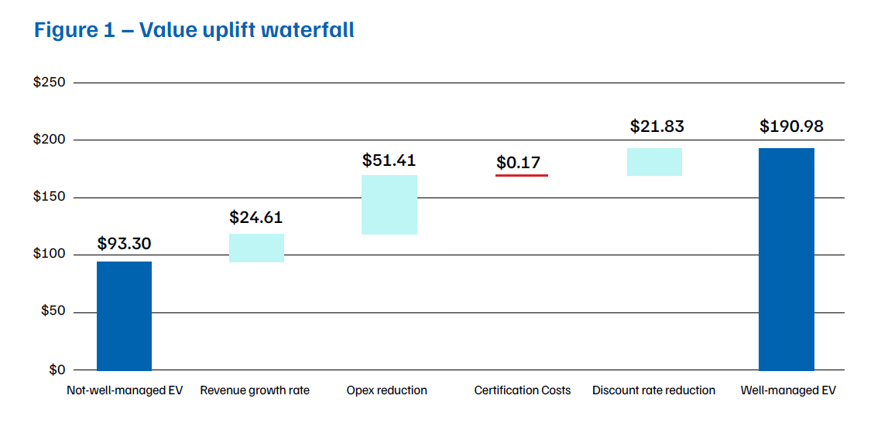
All in, these impacts could double the value of such fisheries (a multiple of 2.05x) in financial model (Discounted Cash Flow – DCF) valuation terms.
Certification also addresses a persistent problem for financial institutions: seafood supply chains are complex and opaque, while credible, independent and standardised data is scarce. Across the globe, there are 789 fisheries working with the MSC, with 624 being MSC certified, and MSC certification offers an independently audited, science-based assessment of the fishery itself.
Ray Dhirani, Head of Capital Markets outreach at the Marine Stewardship Council & Aquaculture Stewardship Council said: “There is valuable opportunity for the financial sector to integrate the risk reduction from the MSC certification process into credit assessment, valuation, and the conditions attached to finance for seafood supply chains. With disclosure frameworks moving towards risk assessments covering specific assets and locations, financiers will find that MSC certification can act as a third-party audited, fishery-level proxy for many of the indicators assessed as financially material for the seafood sector.”
For well-managed fisheries, the MSC’s prototype fishery financial model illustrates that certification costs could be dwarfed by potential revenue growth and long-term cost improvements. It also indicates that certification can lower probability of default, improve creditworthiness, and allow for investment and growth.
The model is built on an illustrative financial scenario based on assumptions drawn from relevant global research and reports. Its aim is to integrate the impact of improvements in fisheries management — such as those achieved in the lead up to and during the MSC certification process — into a discounted cash flow (DCF) model.
Most of that difference comes from the business itself — better margins
from more resilient catches and improved access to markets – while the cost of MSC
certification is a small fraction of a single year’s revenue. Good management shows up in
the accounts, as well-managed fisheries are better for the ocean and support a more resilient long-term economic model.
For more information and to view the model, visit msc.org