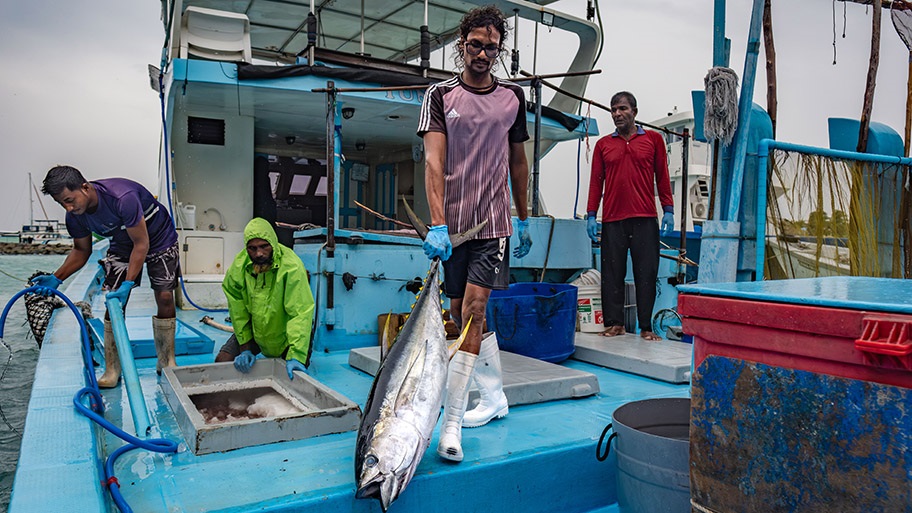
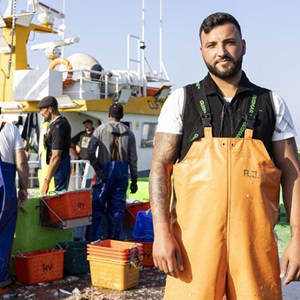
At the docks on Himmafushi, a tiny coral-fringed island in the Maldives, fishermen in shorts and Wellington boots are busy offloading their catch. Their vessel bobs gently in the turquoise water as they reach into iced storage tanks to heave out freshly caught yellowfin tuna, some weighing more than 50kg. The trip has landed more than 2.5 tonnes of fish, and it takes around a dozen people more than an hour to empty the holds.
The average Maldivian consumes more than 3kg of tuna every week, more than anywhere else on earth, and it is the only staple food the island nation does not have to import. Until tourism took off in the 1970s, tuna was the country’s only significant source of foreign exchange. Today, it remains a major earner and provides livelihoods for thousands, particularly in the outer atolls where jobs are scarce.
“For Maldivians, it’s always been about tuna. We grow up eating tuna every day. It’s a part of our culture.”
Maldives tuna fisher
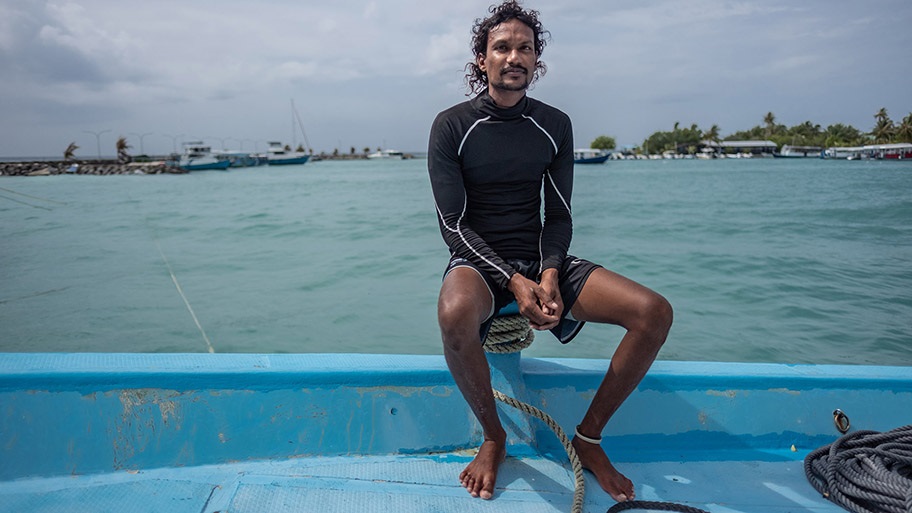
Ibrahim Humaid
Supporting the recovery of Indian Ocean yellowfin
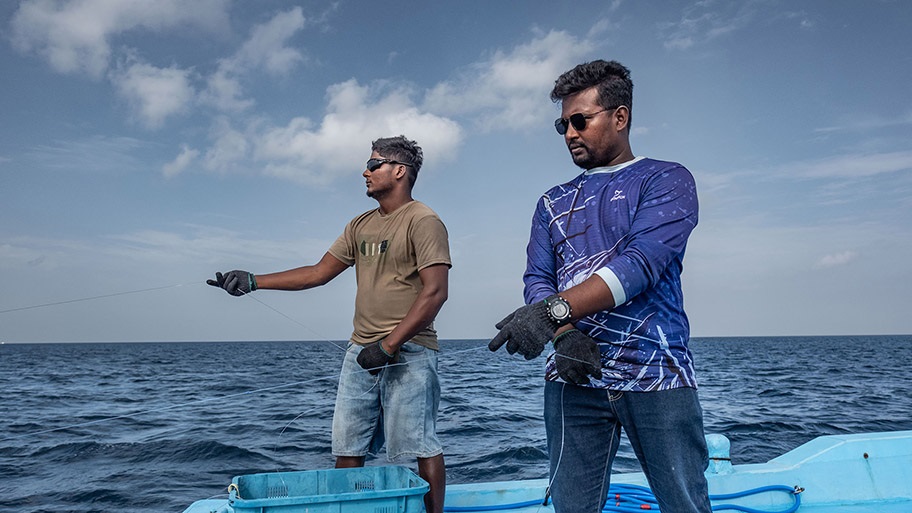
Handline fishing has been central to the Maldives’ yellowfin tuna fishery since targeted fishing for the species began in the late 1990s. Fishers search for seabirds and pods of dolphins that can indicate the presence of a bait ball. Chum – a pungent mix of ground-up fish – is used to draw yellowfin from the ocean depths toward the surface, before fishers cast lines with live bait and wait for a bite. Hauling in each tuna can involve a skilful battle of give-and-take lasting more than 15 minutes.
However, the future of the fishery came under pressure when Indian Ocean yellowfin tuna stock levels deteriorated during the mid-2010s, and the stock was assessed as overfished in 2015. Although yellowfin are highly migratory and caught across the Indian Ocean, the stock status impacted on the Maldives’ ability to sell its fish to an increasingly sustainability-conscious buyer.
The fishery was already facing economic pressure following the loss of tariff-free access to the European export market after the Maldives was reclassified as a middle-income country in 2014. For an island nation where diesel, fishing line and other essentials must be imported, operating costs are high.
“It became really difficult,” says Umar Jamaal, president of the Maldives Seafood Processors and Exporters Association. “We were having a lot of trouble trying to sell our fish. A lot of companies were on the brink of bankruptcy.”
Given this and their geographical challenges, the Maldives were unable to compete with competitors on price. Instead, they focused on leveraging their traditional low-impact fishing practices to promote Maldivian tuna to export markets.
Following the decline in the yellowfin stock, the fishery established a formal fishery improvement project (FIP) to strengthen its management measures. These included pricing incentives to encourage the capture of larger fish rather than juveniles, improvements to logbook systems, increased vessel monitoring, data collection on baitfish stocks and the introduction of a fisher grievance mechanism. The Maldives also committed themselves to regional catch reductions designed to support stock rebuilding.
“It’s out of necessity,” says Hussain Sinan, Director General of Fisheries and Ocean Resources Management in the country’s fisheries ministry. “If we don’t focus on sustainability, both our food security and our culture would be gone. We should and we must ensure that the stock is healthy.
The Maldives became an active voice for stronger regional tuna management through the Indian Ocean Tuna Commission (IOTC), the regional body responsible for managing tuna fishing in the Indian Ocean, submitting conservation and management proposals covering tuna species, sharks and rays, drifting fish aggregating devices (FADs), harvest control rules, and the introduction of limits and precautionary management to help fill gaps identified in fisheries management.
Meeting the gold standard for environmental sustainability
After nearly a decade of rebuilding efforts, scientists concluded in late 2024 that Indian Ocean yellowfin were no longer overfished. In January this year, the Maldives’ yellowfin handline fishery achieved certification to the MSC Fisheries Standard for environmental sustainability in wild-capture fisheries.
The certification provides access to the MSC program and opens the prospect of new relationships with sustainability-focused importers. Within weeks, Maldivian tuna processors were already discussing opportunities with new buyers.
“After MSC certification, we’ve seen that major retailers in Europe are taking notice. They’re working towards sourcing fish directly from suppliers like us. It was a movement that was already happening, but I think MSC certification will be the icing on the cake.”
Big Fish Maldives
Expanding capacity beyond certification
At the Big Fish Maldives processing plant on Himmafushi in the Kaafu Atoll, freshly caught yellowfin tuna are weighed, measured and tagged individually so that products can be traced back to a specific fish. Core samples are taken for quality testing, and temperatures are measured to ensure freshness of the tuna. Workers prepare fresh steaks, loins, cubes and other products for rapid delivery to international markets.
“MSC certification is an important milestone. And the next step is to turn that recognition into long-term buying relationships that reward responsible fishing and support viable livelihoods,” says Shafin. “Consistent demand and fair prices give fishermen and processors confidence to keep investing in quality and sustainability.”
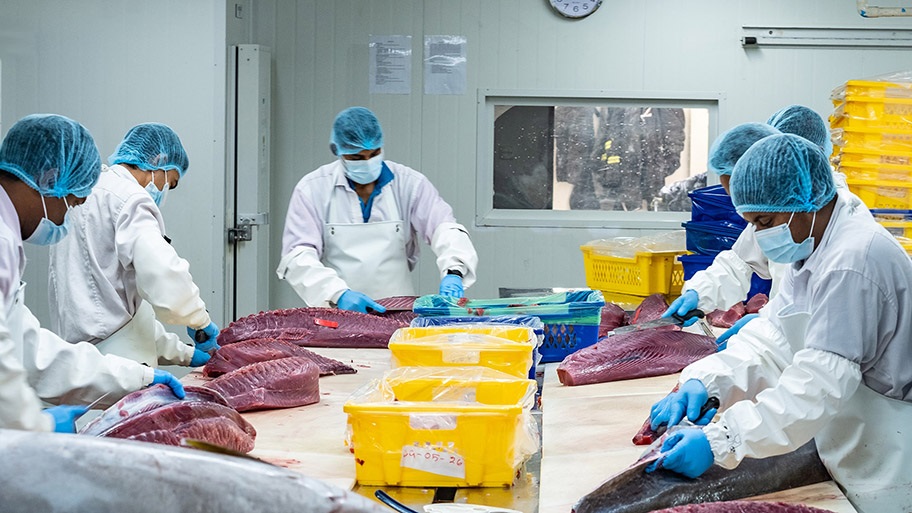
Big Fish processors
The country continues to modernise its iconic fishery, fusing ancient tradition with modern science and technology to stay ahead. Bird radars are being used by many boats to help locate tuna schools, potentially reducing time and fuel use. Processors are investing in ice production plants, cold-chain infrastructure, improved quality control and value-added processing.
The government is also looking to expand processing capacity so that more value from Maldivian tuna remains in the country. Plans include developing new branding for Maldivian tuna, while the state-owned Maldives Industrial Fishing Company (MIFCO) is exploring the possibility of expanding the yellowfin handline fishery into waters in the south of the country.
"Now that the stock is in green, we need to all keep working together to ensure it stays there," says Dr Shiham Adam, one of the country’s leading fisheries scientists.
For Humaid and fellow fishers selling their tuna to Big Fish and other processors, the improved outlook for the fishery offers hope for his livelihood and for the generations of fishing families that depend on tuna. He hopes certification of both their skipjack and yellowfin catches will ultimately help bring higher prices back to fishers."I don’t know if it’s because I grew up around the ocean, or if it’s because I’m from a family of fishermen, but I love this job," says Humaid. "There’s nothing else I’d want to be doing."